Close
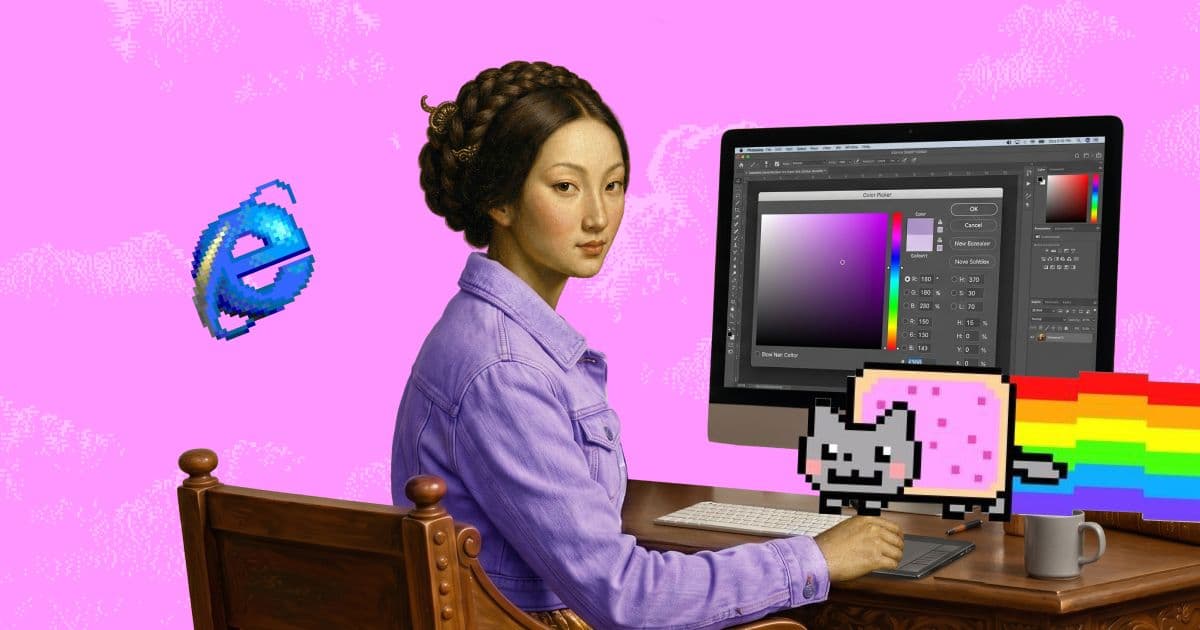


There was a time when design was judged by its ability to stand out in a static world.
Now, its success hinges on its ability to disrupt an endless stream of content. Yet, despite this shift toward the attention economy, the ultimate objective of a designer remains constant: to communicate effectively and build genuine emotional resonance.
The real change lies in our environment and more specifically, in how the abundance of digital inspiration has reshaped the creative process from scratch.
Before Pinterest boards, saved Instagram posts, and endless design galleries, inspiration required effort.
Designers looked to books, magazines, architecture, photography, advertising, and the world around them. If you wanted to study great work, you often had to go find it. You visited bookstores, collected magazine cuttings, attended exhibitions, or simply paid closer attention to the details in everyday life.
Because references were harder to access, designers spent more time sitting with them. A single poster, book cover, or building facade could become the subject of study for days or even weeks.
The process was slower, but it encouraged deeper observation. Instead of constantly looking for the next reference, designers were often focused on understanding the one in front of them.
Ironically, many designers today are rediscovering the value of this approach. In an article by MINT Brand Marketing, they argue that some of the strongest creative inspiration still comes from stepping away from Pinterest and looking at the real world. Nature, culture, conversations, and lived experiences often lead to more original ideas than endlessly scrolling through curated design feeds.
The internet removed many of those barriers.
Suddenly, designers could access work from around the world in seconds. Platforms like Pinterest, Behance, Instagram, and TikTok turned inspiration into an endless stream of images, layouts, campaigns, and trends.
For the first time, a designer in Malaysia could instantly see what agencies in New York, London, Seoul, or Tokyo were creating.
It opened access in ways that previous generations could only dream of.
But it also changed our relationship with inspiration.
The challenge was no longer finding references.
It became filtering them.
Today, most designers have hundreds of saved posts, screenshots, moodboards, and bookmarked projects. Inspiration is no longer scarce. It's abundant.
Sometimes overwhelmingly so.
One of the most interesting consequences of the internet is that design is increasingly influenced by other design.
Before the internet, designers primarily found inspiration from the world around them. Nature, architecture, culture, photography, and human behaviour often served as starting points.
Today, many ideas reach us through another designer's interpretation first.
A layout trend appears on Pinterest. It gets adapted into an Instagram carousel. A brand picks it up for a campaign. A creator recreates it on TikTok. Within weeks, the same visual language is everywhere.
This isn't necessarily a bad thing. Faster sharing has helped designers learn from one another, discover new perspectives, and build global creative communities.
At the same time, it has contributed to a growing sense of sameness across the industry.
In "When Everything Starts to Look the Same", writer Mayank Sabharwal explores how constant exposure to the same platforms, references, and visual trends can lead to the homogenisation of design. When everyone is drawing inspiration from the same places, it's not surprising that similar aesthetics begin appearing everywhere.
Design trends have always existed. The internet simply accelerated their speed and reach.
At the same time, the way people consume content has changed.
In the past, magazine ads, newspaper spread, or billboard often had a few moments to earn attention. Today, content is competing against an endless stream of posts, videos, articles, and notifications.
Design is no longer competing with one message.
It's competing with everything.
According to Aakash’s article on the “Attention Economy”, attention has become one of the most valuable and limited resources online. Every brand, creator, and platform is competing for the same finite amount of human focus.
You can see the effects everywhere. Headlines have become shorter. Typography has become larger. Content is broken into smaller, easier-to-digest pieces. Thumbnails work harder. Visual hierarchy has become more aggressive.
These aren't simply design trends. They're responses to changing user behaviour.
The “Psychology Behind Scroll-Stopping Visuals” by Social Lady points out that elements like contrast, movement, emotion, and visual hierarchy naturally attract attention because our brains are wired to notice what stands out. As audiences became accustomed to fast-moving digital environments, designers adapted by making messages easier to process at a glance.
In many ways, modern design is not becoming simpler because designers are less skilled. It's becoming simpler because attention has become harder to earn.
The biggest shift isn't that designers have more inspiration than before.
It's that inspiration itself changed shape.
It moved from something scarce to something abundant. From something we actively searched for, to something constantly delivered to us.
As a result, the creative process changed too.
Design today often happens in conversation with hundreds of influences at once. Every saved post, recommended video, and curated feed contributes to the visual library we're drawing from.
That isn't necessarily good or bad. It's simply the reality of designing in the internet era.
When people talk about how design has changed, the conversation often focuses on software, AI, or new technology.
But perhaps the bigger story is inspiration.
The internet didn't just give designers new tools.
It changed what we look at, how often we look at it, and where our ideas come from.
In many ways, design used to be a response to the world around us.
Today, it's increasingly a response to both the world and the countless designs we encounter every day.
And that might be one of the most significant shifts the industry has experienced.
References:


October 29, 2025

May 17, 2024
November 29, 2025

 Thank you for your enquiry! We'll respond shortly.