
Close
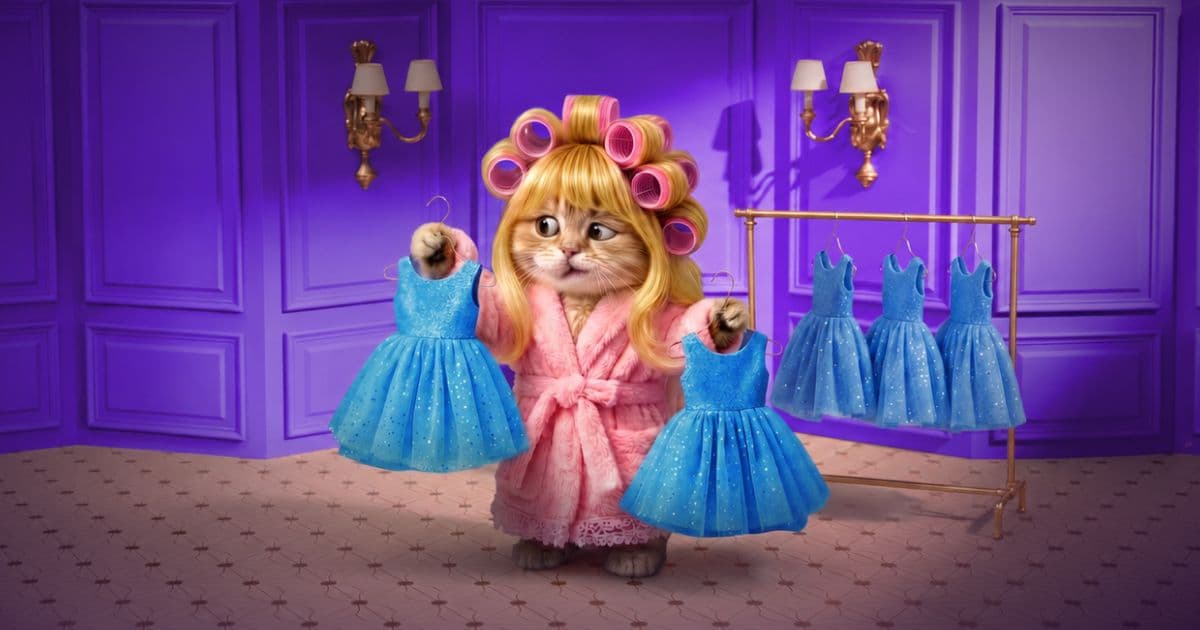



There's a new creative standard quietly taking hold in the industry. It's not excellence. It's not bold ideas. It's not even differentiation.
It's "good enough."
AI has made it easier than ever to produce content—faster outputs, lower costs, endless variations. On paper, that sounds like progress. And in many ways, it is. But there's a trade-off we're starting to feel more clearly. When everything is easy to make, it also becomes easy to settle. And that's where the real risk begins.
Scroll through any feed today and you'll notice something. The content isn't bad. Most of it is… fine. Well-structured. On-brand. Visually polished—but also, strangely forgettable.
That's the paradox of AI-generated creative. It's very good at producing work that passes. It hits the brief, follows the format, ticks the boxes. What it rarely does on its own is push beyond that. You end up with content that is technically competent but emotionally invisible. And when every brand has access to the same tools, "good enough" starts to look exactly the same everywhere.
For a long time, creative work was shaped by constraint. Time, budget, production capacity—all of it forced decisions. You had to choose what was worth making because you couldn't make everything. That pressure, uncomfortable as it was, produced a kind of discipline. It forced creative teams to ask: is this idea actually good, or just acceptable?
AI has removed much of that friction. Now you can generate variations instantly. Explore directions in minutes. Produce in a day what previously required a team and a week. This is a genuine shift and it has opened real doors—for smaller teams, for faster experimentation, for creative work that was previously out of reach on a budget.
But when you remove the constraint, you also remove the forcing function. When everything becomes easy to make, it also becomes easier to stop asking whether it should be made. This is where volume quietly starts to replace judgment—and where the trouble begins.
Here's how it typically happens. A team adopts AI. Output increases. Things feel like they're moving. More posts, more ads, more content across more channels. The dashboard looks healthy. Then, slowly, the metrics start to drift. Engagement flattens. Brand recall softens. The audience doesn't unfollow, they just stop registering that you're there.
Not because they dislike you. Because you've become part of the noise.
Volume without intention is not a strategy. It is a very efficient way to become invisible.
Here's the misconception worth correcting: AI doesn't lower creative quality. It raises the baseline. Any brand, any team, any budget can now produce work that looks considered, polished, and professional. That's genuinely good news.
The danger is what happens next. Teams see that baseline—content that looks good, functions well, causes no problems—and mistake it for the finish line. "Good enough" stops being a safety net and becomes a ceiling. And ceilings are dangerous when no one realises they're standing under one.
The creative problem of the AI era isn't incompetence. It's competent mediocrity, produced at scale, distributed everywhere, indistinguishable from every other brand doing the same thing.
So if "good enough" is the risk, what does better look like in an AI-driven workflow?
It's not about using AI less. It's about using it differently—treating it as a starting point rather than a finish line. The distinction matters more than it sounds. AI is exceptionally good at generating directions. It's less good at choosing between them, knowing when to push further, or sensing when something that technically works doesn't emotionally land.
That judgment still belongs to the people in the room.
With EVA Air, this distinction played out clearly. AI was used to generate travel content at scale—destinations, routes, onboard experiences. The volume and efficiency gains were real. But the work that performed best wasn't the content that came straight from the tool. It was the content where a creative decision had been made on top of it—where someone had looked at the output and pushed it one step further.
Research was first conducted to gather references and attraction imagery, before selected visuals were enhanced in Adobe Photoshop for stronger composition and consistency. The scenes were then reimagined in a fisheye-view style using Midjourney to create a more immersive visual identity.
The process began with studying the real-world appearance of each statue and exploring cinematic camera angles in Midjourney. From there, multiple prompt variations were tested to generate short clips of "statue taking selfies", with each iteration refining movement, framing, and visual consistency until the final footage.
Attraction references were researched and uploaded into Whisk to experiment with camera angles and compositions. After refining the visuals in Photoshop, repeated prompting was used to improve lighting, atmosphere, and camera motion across every clip.
The brands that will stand out in the next few years won't be the ones that used AI the most. They'll be the ones who refused to let it think for them.
When every brand has access to the same tools, the real competition is no longer about output—it's about perspective.
And when that perspective is missing, something else starts to happen: brands don’t just blend in, they begin to look indistinguishable from one another.
If you’re seeing that play out across the region, we explored it further in What Happens When Every Brand Competes in the Same Arena? — where speed, scale, and sameness are reshaping how brands show up in Southeast Asia.

 Thank you for your enquiry! We'll respond shortly.